A British garden rarely lets you do everything at once. There is the washing line, the shed that leans a little, a border that wants more sun than the fence allows, and a patio that looked generous until a table went on it. Seating is where most of those compromises meet.
The saving grace is that seating is the one part of a garden you can rearrange without digging anything up. Get the layout right and a four-metre square courtyard can feel like somewhere you would happily spend a Sunday afternoon. Get it wrong and even a long garden becomes a corridor you walk through on the way to the bins.
What follows is a way of thinking about benches, chairs and tables by garden shape, plus the dimensions that make the difference between a layout that works and one that merely fits.
Start with how you actually sit, not with the furniture
Most people buy a set and then hunt for somewhere to put it. Reverse that. Spend a fortnight noticing where you already gravitate: the step you sit on with a mug, the corner that catches evening sun, the spot where the neighbour's window makes you feel overlooked.
Ask yourself a few blunt questions. Do you eat outside often, or twice a summer? Do you usually sit in twos, or does the family descend at weekends? Do you want to read in shade, or chase the sun with a glass in hand?
Then watch the light and the wind. A south-facing garden gets sun for most of the day; a north-facing one stays cool and shaded, which is a gift in a heatwave and a trial in April. Evening sun comes from the west, so if you finish work at six, the far end of a west-facing plot may be the best seat you own. Wind often funnels along side returns and between houses, so a bench against a fence can be bracing while three metres away it is perfectly still.
Small gardens and courtyards
In a space under roughly four metres square, the temptation is to buy several small pieces and dot them about. Resist it. Two half-hearted seating areas feel worse than one good one.
Pick a single anchor point, usually a corner or a wall, and build around it. A bench placed against the boundary keeps the middle of the garden clear, which is what makes a small space feel calm rather than crammed. Add two folding or stacking chairs and a bistro table and you have a set-up for four that can shrink to one.
Round or square tables generally serve a tight corner better than rectangles, because nobody ends up shuffling sideways to get past a sharp edge. Built-in bench seating with storage underneath is worth considering if the garden doubles as a shed.
Leave at least 60cm of clear space between the front edge of a chair and anything solid behind it. Less than that and people perch rather than sit.
Narrow gardens and side returns
A long, thin plot is the most common British shape and the most commonly mistreated. The standard mistake is lining both boundaries with furniture and leaving a thin strip of paving down the middle, which turns the garden into a hallway.
Try turning the furniture across the width instead. A bench set sideways at the far end, facing back towards the house, gives you a destination and a view of the whole garden rather than a view of a fence. It also stops the eye at a comfortable point instead of sending it down a tunnel.
Keep one clear route along the length, and put seating on one side only. In a side return under about 2.5 metres wide, skip dining altogether. Two comfortable chairs and a small table you can move is a better use of the space than a four-seater set nobody can walk past.
Medium gardens: divide the space into zones
Once you have eight metres or more, the problem changes from not enough room to no reason to walk to the end. Zoning solves both.
Think in two or three areas rather than one. Dining near the house, where the kitchen door and the trays are. A pair of chairs further down for evening drinks. A single bench in the shadiest corner for hot afternoons. Give each one a purpose and you will use all of them.
Separate the zones with something low and soft. A change of paving, a gravel strip, a long planter, a clipped box hedge, a step. None of this needs to be expensive or permanent. The aim is that each area feels like a room with edges, not a car park with chairs on it.
Dimensions worth knowing before you buy
Furniture that looks fine in a showroom can be a nuisance in a garden. These are the rough figures worth checking against your own measurements:
- Walkways: allow 60cm for one person to pass comfortably, and 90cm or more where you will carry trays or two people will cross.
- Dining tables: about 60cm of table edge per person for a relaxed meal, and seat height around 43–46cm to match a table 70–75cm high.
- Conversation: chairs roughly one to 1.5 metres apart feel natural. Much further and people raise their voices.
- Boundary clearance: leave 30–40cm behind a bench so you can clean, paint and plant without moving it.
- Low tables: coffee tables sit around 40–45cm high, and work best beside chairs rather than in front of a bench.
Check the depth of chairs as well as the width. A deep recliner takes up far more floor than it appears to, and on a small patio that is the difference between a usable space and a squeeze.
Weather, weight and storage
British gardens punish furniture. Rain, wind and months of damp do more damage than sun ever will, so choose with the winter in mind.
Weight matters in two directions. Light furniture blows over and needs storing; heavy furniture is difficult to move and may not suit a raised deck, so check what the structure can take before you commit.
Cushions should come inside when the weather turns, whatever the label says. Covers are useful for short breaks in the rain, but putting one over damp furniture traps moisture against the frame, which is worse than leaving it out. Stackable and folding pieces are unglamorous and enormously practical if space is tight.
A layout you can test before you spend anything
You do not need to buy a thing to find your best arrangement. Measure the space, then mark it out with what you have: kitchen chairs, cardboard boxes, a bucket standing in for a table. Sit in each position at the time of day you would actually use it.
Live with it for a week. Move things. Notice which seat you keep returning to and which one nobody touches, then plan your purchase around the answer.
If you get one thing right, make it this: leave more walking space than feels necessary and buy slightly less furniture than you think you need. Gardens that feel generous are usually the ones with room left over.
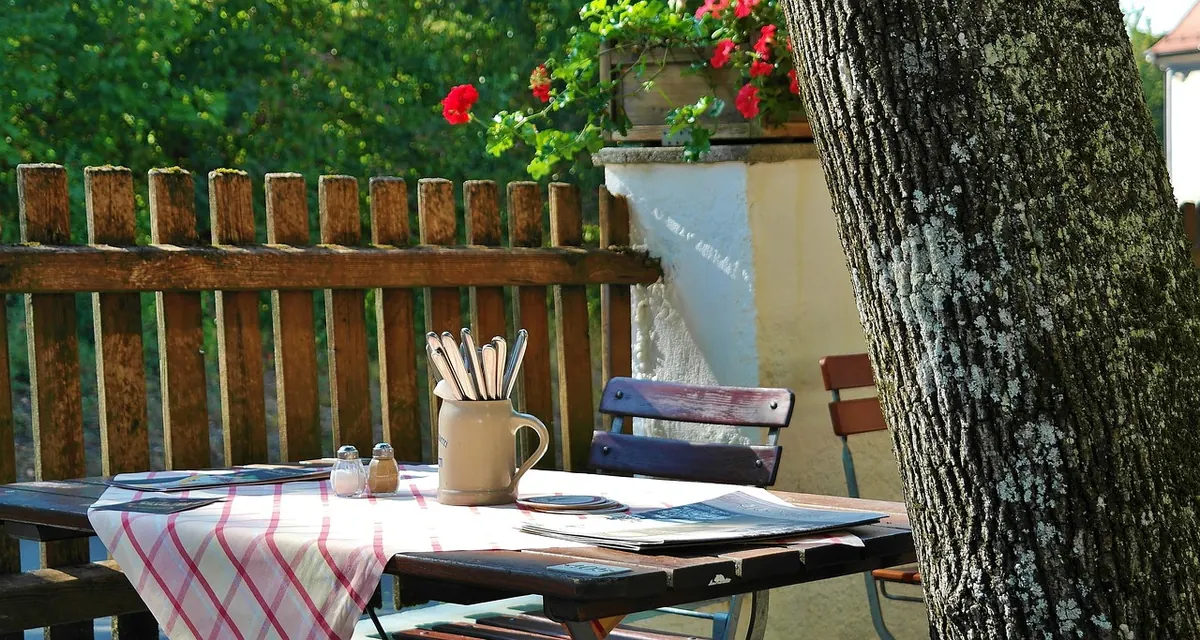
Photo: RitaE / Pixabay