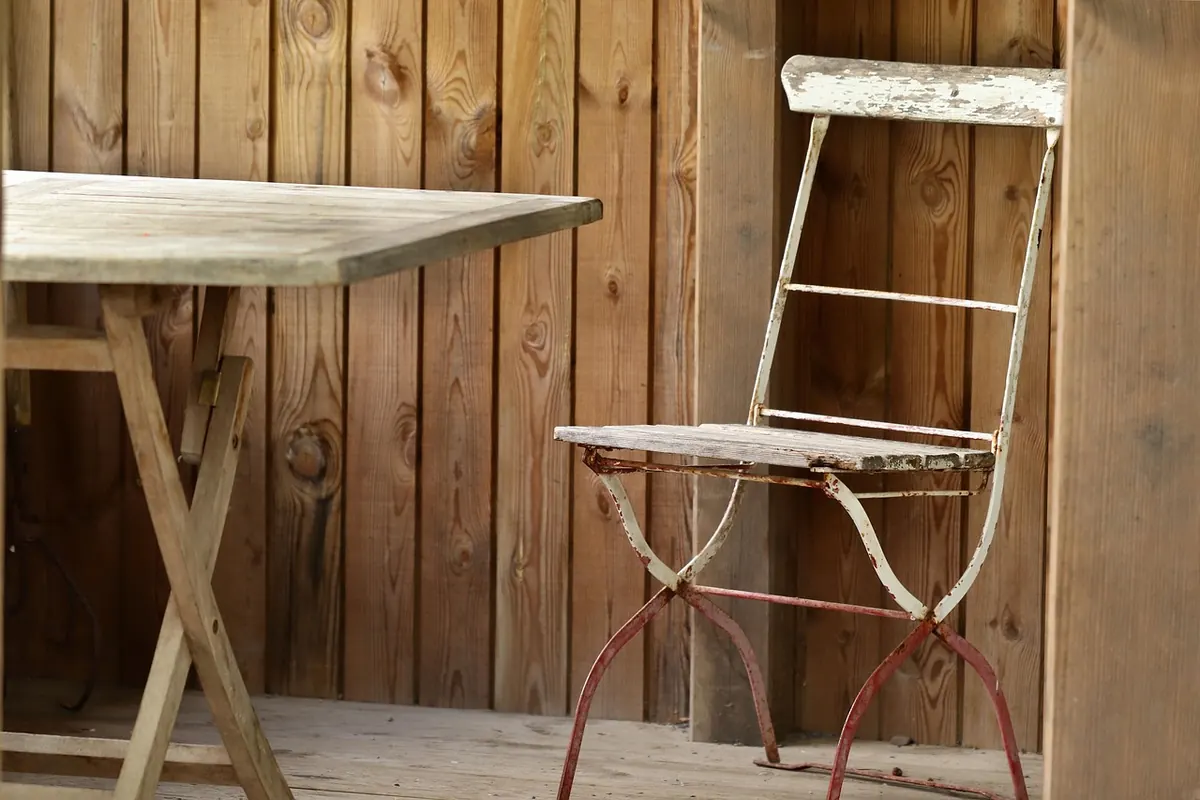
Well-made wooden garden furniture has a long life in it. A teak bench that has stood outside for a decade often has another fifteen or twenty years left, and buying it second-hand costs a fraction of new. That same bench, though, left in a damp corner and never touched, can be a wobbly pile of firewood wearing an attractive grey patina. The difference is almost always visible before you hand over any money — you just need to know where to look. Take a torch, a small flat-head screwdriver, an old towel to kneel on, and give yourself twenty unhurried minutes.
Start With the Shape, Not the Surface
Stand back a few paces and look at the piece as a whole before you get close enough to be distracted by grain and colour. Wood moves over the years, and a frame that has twisted badly tells you something about how it has been stored and how much work lies ahead.
Things to check from a distance: do all four feet sit flat on the ground, or does it rock? Is the back rest of a bench still square to the seat, or leaning to one side? Are the seat rails bowed? Walk around it and look from all four sides, then crouch and look underneath — the underside is where the honesty lives. If you can, tip it over (get help with anything heavy) and sight along the length of each rail with one eye closed. A curve or a twist will show up as an obvious shadow.
Rot: Probe, Don't Assume
Grey, silvery, dry-looking timber is weathered, not rotten. Weathering is fine and often improves the look of oak or teak. Rot is soft, dark and crumbly, and it usually starts where water sits.
- The bottom 10cm of every leg, and the feet themselves
- Where rails, stretchers and legs meet, because joints hold moisture
- The undersides of tabletops, arms and seat slats
- Around every screw, bolt and nail, and any old fixing hole
- Along the base of slats and anywhere timber sits close to soil or paving
The thumbnail test, then the screwdriver test
Press a thumbnail into the suspect area. Sound timber resists; soft timber gives. Then push the tip of a small screwdriver in gently. If it sinks in more than a couple of millimetres, or if the wood crumbles and comes away in flakes, that is rot. Tap along the rails with your knuckle as well: a sharp, ringing note means solid timber, a dull thud means trouble inside.
A small patch of rot on a single slat can be cut out, treated and filled, and it may be worth doing. Rot in a load-bearing leg, or at the point where a leg meets a rail, is a different proposition. That is structural, and repairing it properly is a job for someone who knows what they are doing. On a cheap piece, walk away.
Woodworm and Other Borers
Look for small round holes, roughly one to two millimetres across, often in clusters rather than evenly spread. Nail holes and old screw holes look different — they are usually cleaner-edged and appear where you would expect a fixing. Borer holes are random.
The important question is whether they are active. Hold a sheet of white paper under the piece, tap the timber above it, and look for fine dust — frass — landing on the paper. Fresh frass means live insects. Old holes with darkened edges and no dust are usually historic and often harmless once the timber is dry. Check undersides, joints and shaded areas, because borers favour damp, softer timber. If you find signs of active infestation in a piece you plan to keep indoors or near the house, take advice from a timber treatment specialist before you buy rather than after.
Joint Movement and Fixings
Grip one corner of a bench or table and try to rock it gently. A well-built piece will have a little flex and then settle. If it rattles, shifts sideways, or you can see daylight opening at a joint, the fixings have loosened or the timber around them has worn.
Look closely at the hardware. Stainless steel or galvanised bolts and screws are a good sign. Rusted fixings that have left black staining running down the timber mean water has been sitting there for years. Try tightening one bolt — if the wood around it crushes easily, the timber is soft and the joint will never hold properly again.
Now look for evidence of past repairs: screws driven in at odd angles, metal plates or brackets, dowels that do not match the rest, filler or silicone smeared into joints. Repairs are not automatically a reason to say no, especially on an older piece that has been loved. But they should affect what you are willing to pay, and they should make you look harder at the surrounding timber.
Previous Treatments and Finishes
Ask what has been applied and when. Oil, stain, varnish, paint, or nothing at all — each tells you something different.
Bare, weathered timber simply needs cleaning and oiling. A recent coat of oil is easy to work with. Flaking varnish is a warning: it traps moisture underneath, and the wood below is often darker and softer than it looks. Thick paint can hide filler, cracks and rot, which is exactly why you probe before you commit.
If the seller does not know what is on the piece, treat that as a job rather than a bonus. Sanding off an unknown finish is messy work, and some older treatments are best handled outdoors, with gloves and a mask, rather than in a workshop. If you are unsure what you are dealing with, ask a specialist.
Questions Worth Asking Before You Commit
- How old is it, and has it been outside the whole time?
- What wood is it — teak, iroko, oak, acacia, pine?
- Has it ever been treated or painted, and with what?
- Has anything been repaired or replaced, and where?
- Has it been stored under cover, in a shed, or out in the open?
- Does it come apart for transport, and are the bolts free?
- Can I see it in daylight rather than under a porch light?
That last one matters more than it sounds. Damp patches, fresh filler and colour differences are far easier to spot at eleven in the morning than at eight in the evening.
Getting It Home Without Damaging It
Measure your car, van or trailer before you set off, and take two people for anything longer than a two-seater. Bring old blankets, ratchet straps and the right spanner in case the legs need to come off. Strap across solid rails rather than across a joint, and never lift a table by its top alone. If dismantling is involved, check the joints as they come apart — this is when hidden rot shows itself, so if you can inspect before paying, do.
Making the Call
Second-hand wooden garden furniture is usually better value and a good deal kinder to the environment than buying new, but only if you can see the work clearly. Walk away if there is rot in a leg or a main joint, if the frame is badly twisted, or if active woodworm runs through load-bearing timber. Buy with confidence if the timber rings sharp under a knuckle, the joints tighten up with a spanner, and the only finish needed is a clean and a coat of oil.
If you are torn, ask to come back in daylight with a friend who has restored furniture before. A second pair of eyes on a bench is worth more than any amount of squinting at photographs.
Photo: Felix-Mittermeier / Pixabay